I am an avid succulent collector and enjoy the Genus Pachypodium. I currently grow 5 species namaquanum, brevicaule, inopinatum, griquense and succulentum. There are approximately 25 species mostly from the island of Madagascar with 5 found in South Africa. Its derivation is from Greek (Pachus)- thick , (podion)- foot. Thick-footed.
Pachypodium caudices and branches are thickened with water-storing tissue. When drought/dormancy occurs they rely on these storage organs to sustain them until they begin growing again.
Part of my reason for going to South Africa this past January was to see succulents and all manner of flora quite frankly. I saw the beautiful Pachypodium succulentum in the Eastern Cape of South Africa growing in stony arid soil. It was not in bloom but full leaf . This plant is a Geophyte as its caudex or tuber ( storage organ) is below the soils surface as seen below.
My plant is currently in bloom and is growing into a nice caudifiorm. It is a slow-growing plant but one of the most floriferous of the Genus. The flowers are pink with a red stripe down each petal.
.
Lily Lion Heart
Saturday, 31 March 2012
Thursday, 22 March 2012
Awe-Inspiring Asarum!
A few years back I bought a booklet on Japanese and Chinese Asarum. The Japanese know how to grow plants in pot culture and boy can they display their plants. This art of horticulture, meticulous display and love of the natural world has existed for many centuries in Japan and is evident in the Genus Asarum, Hepatica, Cymbidium to name a few. They display these gems with such zeal, passion and skill that it stops one in their tracks.
The book came from the now defunct nursery Asiatica. The book is in Japanese with and English translation in a separate booklet. It primarily focuses on Japanese Asarum but mentions Chinese, North American and European species. It features both species and many cultivars. It is a beautiful piece of art really and I recommend it just for the pictures alone. It conjures up images of show benches of Asarum in a Zen garden replete with a temple and tea ceremony in the foreground.
The plant in my post is Asarum maximum `Green Panda`. Native to Hubei and Sichuan China it is hardy to 10F. It should be grown in part to full shade always kept moist. Mine grows in my cold greenhouse for the Winter and stays evergreen. The flowers are a beautiful velvety soft chocolate colour with white centres. Asarum is in the Aristolochiaceae family or birthwort family, known as Wild Ginger.
Sunday, 18 March 2012
Tecophilaea cyanocrocus
This beautiful Genus of two species comes from Chile; cyanocrocus and violiflora. They call this the blue crocus, but in fact it is not a crocus nor is it related. It is in the family Tecophilaeaceae. Cyanocrocus which I grow comes from the Cordillera of Santiago at around 3000m.
They are believed to be endangered in the wild due to over-collecting, overgrazing and human encroachment.
They are known for their intense breathtaking blue flowers with a white centre. In the wild they bloom October-November which is spring in the Southern Hemisphere and in northern climates (Winter)February-March.
They are tender therefore I grow mine in the cold greenhouse. Each inflorescence can produce 1-2 blossoms. I use a well-drained soil which I keep moist during the winter. In summer they are dormant and kept bone dry in shade. They do not enjoy a summer-baking as most bulbs do during dormancy.
They are believed to be endangered in the wild due to over-collecting, overgrazing and human encroachment.
They are known for their intense breathtaking blue flowers with a white centre. In the wild they bloom October-November which is spring in the Southern Hemisphere and in northern climates (Winter)February-March.
They are tender therefore I grow mine in the cold greenhouse. Each inflorescence can produce 1-2 blossoms. I use a well-drained soil which I keep moist during the winter. In summer they are dormant and kept bone dry in shade. They do not enjoy a summer-baking as most bulbs do during dormancy.
Saturday, 10 March 2012
Brazilian Bombshell-Sinningia Leucotricha
Sinningia is a genus of flowering plants in the Gesneriaceae family. It is named after a German gardener Wilhelm Sinning (1792-1874) who worked at the Botanical Gardens of Friedrich-Wilhelms University in Bonn.
There are approximately 65 species. Their range is Central and South America with the greatest speciation is southern Brazil. They often grow on rocks or cliffs and most are pollinated by hummingbirds and bees.
This plant is truly a Brazilian Bombshell which is my name for it. I have had it for over 10 years and every year in late winter I enjoy the apricot-reddish tubular flowers of this stunner. I imagine the hummingbirds having a nectar feast. I give it a rest in November and leave it in my cool sunny west windowsill. By January the new growth appears and I begin to water again. As it is a tuberous plants it should be dormant some part of the year as it is in the wilds of Brazil nourishing itself from its tuber. I grow my raised to accentuate the caudex-like tuber. The inforescence is thick and silvery,as soft as the finest mohair.
There are approximately 65 species. Their range is Central and South America with the greatest speciation is southern Brazil. They often grow on rocks or cliffs and most are pollinated by hummingbirds and bees.
This plant is truly a Brazilian Bombshell which is my name for it. I have had it for over 10 years and every year in late winter I enjoy the apricot-reddish tubular flowers of this stunner. I imagine the hummingbirds having a nectar feast. I give it a rest in November and leave it in my cool sunny west windowsill. By January the new growth appears and I begin to water again. As it is a tuberous plants it should be dormant some part of the year as it is in the wilds of Brazil nourishing itself from its tuber. I grow my raised to accentuate the caudex-like tuber. The inforescence is thick and silvery,as soft as the finest mohair.
Sunday, 4 March 2012
Spring is in the Air!
Sunday, 26 February 2012
Summer-Rainfall Brunsvigias
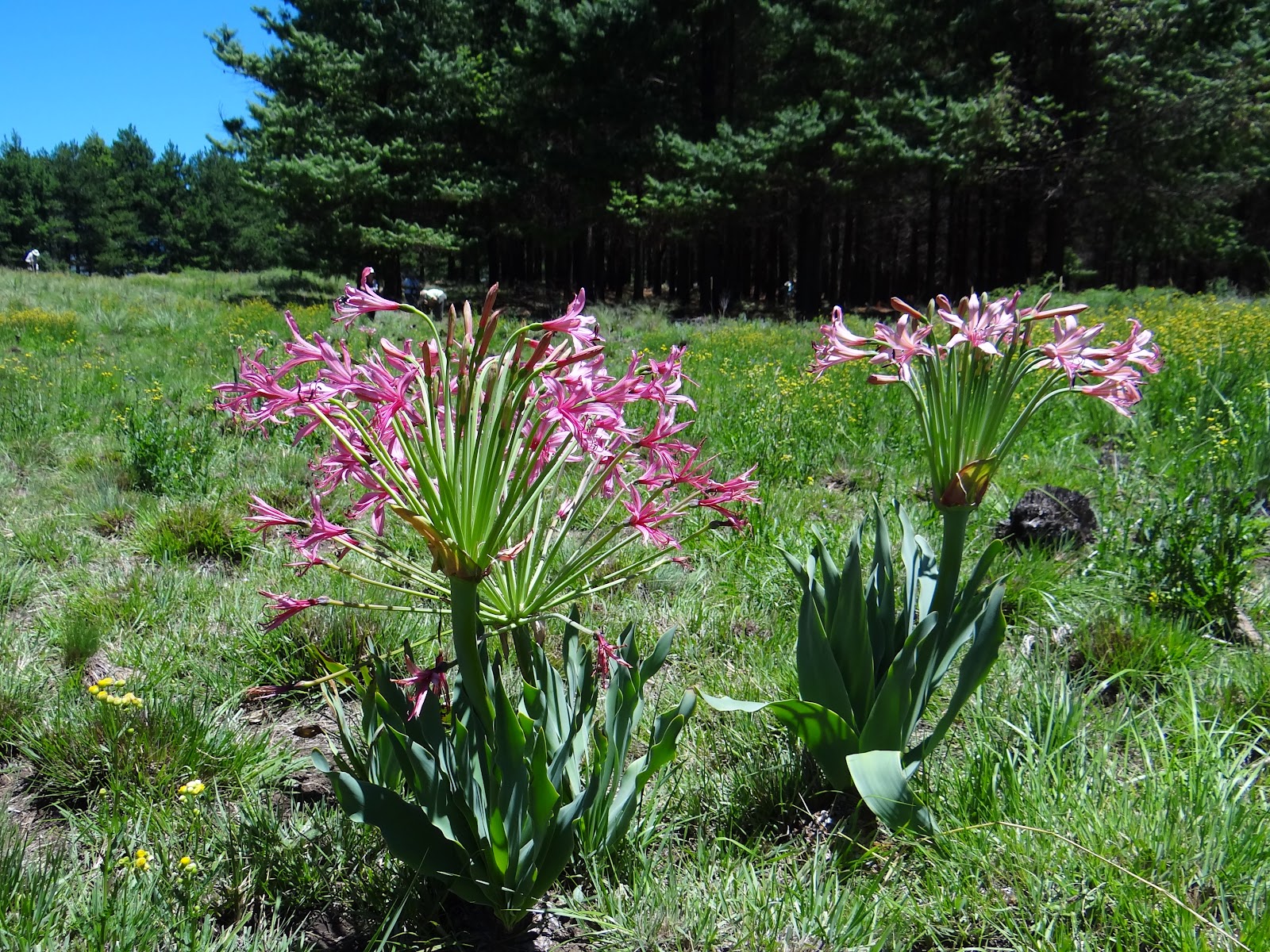
From my recent trip to South Africa I wanted to highlight the beautiful genus Brunsvigia (which honours the German House of Brunswick). They are known as the Candelabra Flower. There are some 20 species in the family Amaryllidaceae which grow in the semi-arid regions of South Africa. They produce amazing displays of colour in autumn. They are mostly winter-rainfall growers, however the two in my post are summer-rainfall growers.
Brunsvigia grandiflora- pictured in Maclear, Eastern Cape. It is 80cm tall and found in scattered grasslands at 1200-2300 m. It grows it leaves and flowers at the same time. Its leaves are 10-15 and the bulb is large. Its flowers are pink containing some 30-60 in a spreading inflorescence. In the wild it blooms from Jan-March.
Brunsvigia radulosa- photographed in Barkly East is also widespread in grasslands in higher altitude summer-rainfall regions of the Eastern Cape. The flowers are red blooming January or February in the wild.
Saturday, 11 February 2012
Ohhhh my precious Dionysia!!
Today I ventured outside and opened my greenhouse to view my beautiful Dionysia in full bloom. The daily temperature was a frigid -10 C with a windchill in the -20's. Brrrr. I had to take pictures rather quickly due to the cold as I have other tender South African bulbs in this greenhouse.
For those who do not know I have a penchant or shall we say obsession with the genus Dionysia. They are my favourite alpine and one of my favourite Genera period.
There are some 45 species of which two I grow. In the wild they mostly inhabit shaded or partially shaded cliffs and rocks. The summers are hot and extremely dry, the winters generally intensely cold with most precipitation falling as snow or early spring rains. They are a challenging alpine, although the two I grow are somewhat more manageable D. aretioides 'Bernd Wetzel' and D. tapetodes.
I swoon when I look at these plants. They are very precious to me. I call them my Persian Gems. D. aretioides comes from the Elburz mountains of Iran while tapetodes comes from NE Iran to Afghanistan. They cannot tolerate winter wet on their crowns and must be grown under glass or outdoors as nurseryman Harvey Wrightman does in a scree garden tucking them underneath layers of shale ( simulating a cliff if you will) keeping their crowns dry.
Dionysia aretioides
Dionysia tapetodes
For those who do not know I have a penchant or shall we say obsession with the genus Dionysia. They are my favourite alpine and one of my favourite Genera period.
There are some 45 species of which two I grow. In the wild they mostly inhabit shaded or partially shaded cliffs and rocks. The summers are hot and extremely dry, the winters generally intensely cold with most precipitation falling as snow or early spring rains. They are a challenging alpine, although the two I grow are somewhat more manageable D. aretioides 'Bernd Wetzel' and D. tapetodes.
I swoon when I look at these plants. They are very precious to me. I call them my Persian Gems. D. aretioides comes from the Elburz mountains of Iran while tapetodes comes from NE Iran to Afghanistan. They cannot tolerate winter wet on their crowns and must be grown under glass or outdoors as nurseryman Harvey Wrightman does in a scree garden tucking them underneath layers of shale ( simulating a cliff if you will) keeping their crowns dry.
Dionysia aretioides
Dionysia tapetodes
Subscribe to:
Posts (Atom)