Polygonatum prattii is one of my favourite of the genus. I currently grow P. hookeri, P. falcatum, P. prattii and soon P. aff. graminifolium. The Chinese Polygonatum are delightful. I look forward to their appearance every year, as it is amongst some of the later plants to make their debut in the garden. They are a north temperate genus of approximately 60 (39 in China, half endemic. They are rhizomatous perennials with pendulous flowers, solitary or clustered at the nodes. Prattii is 30cm and comes from w. to sw. Sichuan, and nw. Yunnan.
.
Lily Lion Heart
Sunday, 10 June 2012
Monday, 4 June 2012
Captivating Cypripedium
In 2009 my Father and I travelled to Tobermory and Flowerpot Island on Georgian Bay in the Grey-Bruce Peninsula. This trip was with the Southern Ontario Orchid Society. This region is rich with native orchids and other native flora and it didn't disappoint. I took many photos at the time with my Blackbery, and wish I would have invested in a REAL camera, a Digital SLR. I saw the beautiful C. reginae, arietinum, parviflorum and calceolus. C. calceolus was ubiquitous in habitat. What a sight to see! Seeing plants in habitat is what I get excited about. I currently grow C. parviflorum v. Makasin, C. reginae, and C. x alaskanum. Let me say that none were wild collected, as I am not a proponent of that, however if they were going to be bulldozed for a housing development, I would be there in a heartbeat with trowel in hand to save the plants I could.
C. parviflorum v. Makasin- They grow in fens and wet forests, however in cultivation they prefer mesic conditions. If they are grown in soil that isn't too rich in organic matter and lean towards the sandy side they will increase readily. They are found from Alaska across Canada to the southeastern U.S. This is one of the easy Cyps. to grow. They have lovely dark maroon sepals and petals, and are sweetly scented.
C. reginae- is one of the showiest Lady's Slippers and another one that is fairly easy in cultivation. In nature is grows in calcareous fens, however in cultivation does not prefer wet conditions, but rather well-drained mesic composts. It has been overpicked and should be protected from further exploitation due to its pulchritude. It's especially common in the Great Lakes region and its range is from Saskatchewan east to Newfoundland, south to North Carolina, west to Arkansas and north to Minnesota. The glandular hairs of the foliage may cause a rash similar to that caused by Poison Ivy, of which I am immune.
C. x alaskanum-is a natural hybrid between C. guttatum and C. yatabeanum confined to Alaska , Kodiak Island and the Aleutians. It is a tiny orchid (probably the size of a quarter) with lovely pink spotting on the lip, sepals and petals. Sadly this year I had one bud which was about to open, and within a few days after that the bud was brown. I was, and am still perplexed. The picture of this diminutive gem is from last year. I grow it in a rich moist compost in the shade.
Thursday, 31 May 2012
Hymenocallis harrisiana
This New World genus in the family ( Amaryllidaceae) comprises some 70 to 80 species. The native habitats range from the south-eastern United States across Alabama, Louisiana, Texas and Mexico where the genus is prolific. The majority of the species occur in Central America and dip down into South America (Venezuela, Guyana, and Brazil). H. harrisiana comes from Mexico. The strap shaped leaves are glaucous. The flowers have a small scented white corona which look spider-like and airy. Each flower lasts only one night and the fragrance intensifies in the evening. They have a delicate stigma and the anthers protrude out and dangle in the breeze. The blooming period is short lived, however I get a second flush of bloom. This post is for you Anna. Enjoy!
Saturday, 26 May 2012
Milky Milkweeds (Asclepiads)
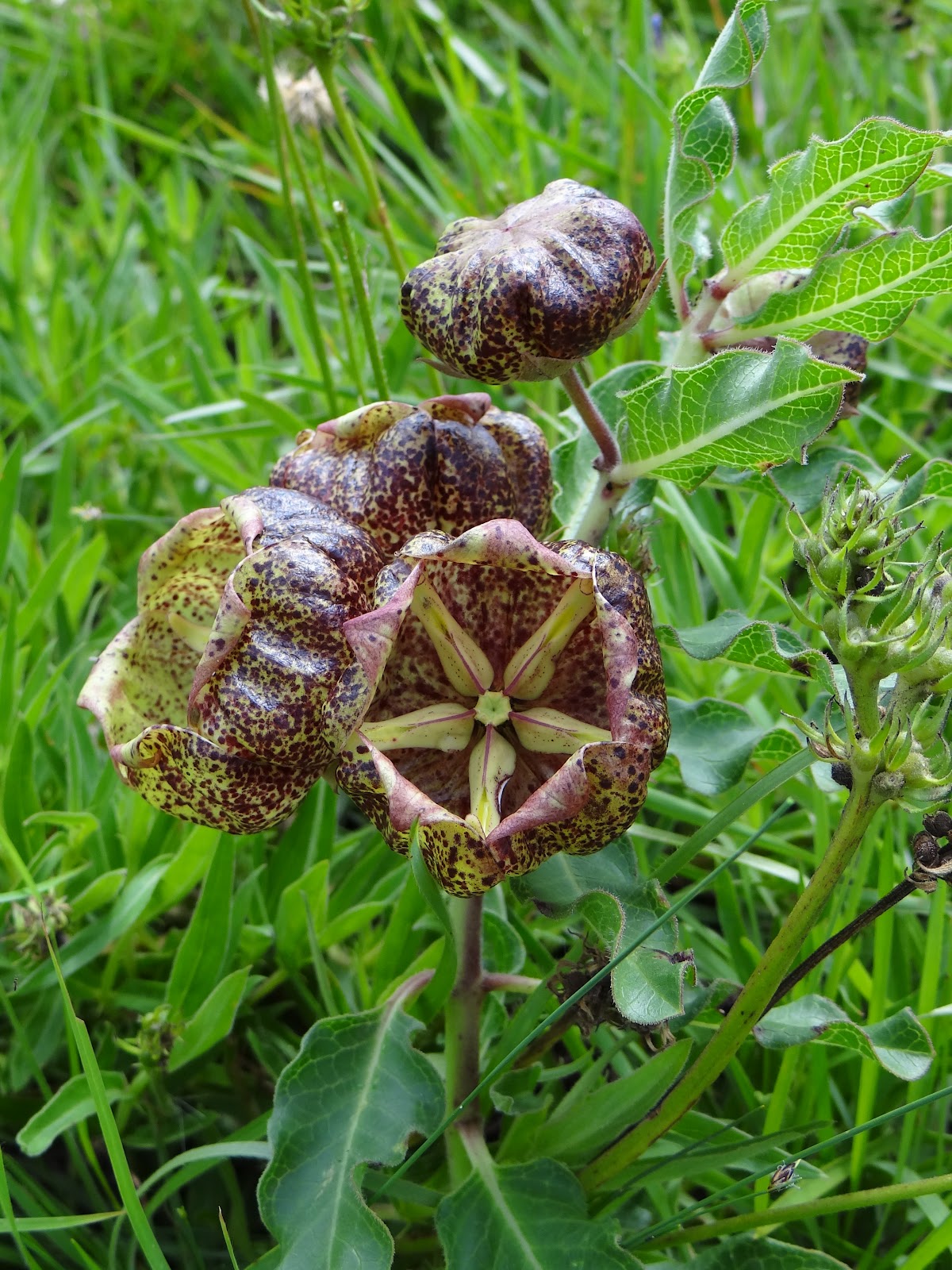
Pachycarpus makes up some 37 species and are found throughout much of sub-saharan Africa in grasslands or open woodland. They have stout annual stems arising from a tuberous rootstock. The species found below grow in the Eastern Cape and Kwazulu-Natal in grasslands.
| P. concolor |
| P. reflectens |
| P. grandiflorus |
| P. grandiflorus 'yellow form' |
| P. campanulatus |
Saturday, 19 May 2012
Dazzling Delosperma
| Delosperma congestum ( my garden) |
| Delosperma daveyi ( in my trough) |
![]() |
| Delosperma crassuloides (Gaikaskop, SA.Amatola Mtns. from my trip Jan/2012) |
| Delosperma lavisiae growing in Basalt 2500M (Naudes Nek , SA Drakensburg Mtns from my trip Jan/2012) |
| Delosperma sp. with Crassula setulosa set in background Drakensburg Mtns. SA |
Sunday, 13 May 2012
Matthiola anchoniifolia
There are some beautiful and strange Turkish endemics and Matthiola anchoniifolia is one of them. First thoughts are that they must have fragrance like the familiar annual garden cultivars and rather unexciting flowers. Well indeed they do have a lovely scent BUT are certainly exciting and unique in my opinion. This plant is far under-rated as a trough plant. They are perennial and form tufts of linear crinkly- edged leaves, covered with white tomentum, giving it an aqua-green hue. It flowers in early May and the floral display is understated,but nevertheless very alluring. Four thin petals unfurl like chocolate dusty-pink petifours. The flowers are held close to the stem in a short raceme; and do fade to a pale cocoa colour. They are long lasting and are set off beautifully against the backdrop of tufa. They are under 15cm with flowers and grow amongst rocks in the mountains of Turkey above 1500m. They enjoy full sun, lean soil and are very much at home in a trough. On bent knees the scent is worth it!
Sunday, 6 May 2012
Gorgeous Gentiana
Those that know me know that Gentiana is one of my favourite genera. Who can resist that indescribable azure blue colour. They like few other genera i.e. Meconopsis, Tecophilaea, Eritrichium, have a very unique blue in the plant kingdom. I grow the spring blooming European species and the fall blooming more challenging and pernickety Chinese species.
For the layman the trumpet gentian, apart from edelweiss, is the archetypal alpine flower.
Spring flowering gentians are divided into two groups, the acaulis group and verna group.
The pan below is of G. angustifolia and dinarica. Both are lime loving and enjoy full sun. Flowers are a dreamy deep royal blue with olive green longitudinal throats and are 2-3 " long.
G. angustifolia- comes from the south-western Alps and also in the Jura and Pyrenees
G. dinarica- comes from the Balkans
Gentiana verna- is found in the Alps, Balkans and Pyrenees. Deep azure-blue flowers. Lime tolerant.
Sources are:
Gentians- Fritz Kohlein- published by Timber Press- no longer available, however used copies are.
Flowers of Western China- Christopher Grey-Wilson and Phillip Cribb.
For the layman the trumpet gentian, apart from edelweiss, is the archetypal alpine flower.
Spring flowering gentians are divided into two groups, the acaulis group and verna group.
The pan below is of G. angustifolia and dinarica. Both are lime loving and enjoy full sun. Flowers are a dreamy deep royal blue with olive green longitudinal throats and are 2-3 " long.
G. angustifolia- comes from the south-western Alps and also in the Jura and Pyrenees
G. dinarica- comes from the Balkans
Gentiana verna- is found in the Alps, Balkans and Pyrenees. Deep azure-blue flowers. Lime tolerant.
Sources are:
Gentians- Fritz Kohlein- published by Timber Press- no longer available, however used copies are.
Flowers of Western China- Christopher Grey-Wilson and Phillip Cribb.
Subscribe to:
Posts (Atom)