.

.
Lily Lion Heart

Saturday, 28 July 2012

Unusual Uncarina

Every summer I look forward to the blossoms of the beautiful caudiciform Uncarina roeoesliana. This Genus is in the Sesame family, and contains 11 species. They are endemic to Madagascar. Every Spring I lop off the current growing points, bring it outside in the cool greenhouse and let it regrow new shoots. In May or June I then put the pot on my stairs, where it enjoys full sun.  This year I have one growing point, and it has been blooming for over a month now. When you touch all parts of the plant (except caudex)you get this sesame like odour, quite harmless, but strong. The seed capsules are odd looking, and have hooks or horns on them. The lovely deep yellow flowers only last a couple of days, and then fall off onto the pot surface. I always think they have so much more life left in them. Pity really as they are breathtaking. Life is often fleeting! Madagascar is on my bucket list of countries to travel to for a botanical trip. Very strange oddities indeed!


Saturday, 14 July 2012

Sizzling Summer Days

Well it has been a very dry hot summer, to say the least. Very sad indeed, a sign of global warning. It has been a challenging year in general for plants as we had a dry winter, spring and now summer.  I lament daily "Will it ever rain again ". I water the grass daily, and must keep an eye on all my plants and water accordingly. It's a bit tiring quite honestly, but I'm not going to complain. At least my collection looks healthy and the grass verdant. Some RAIN however would be AMAZING! One has to keep the faith. Please, please, please!  

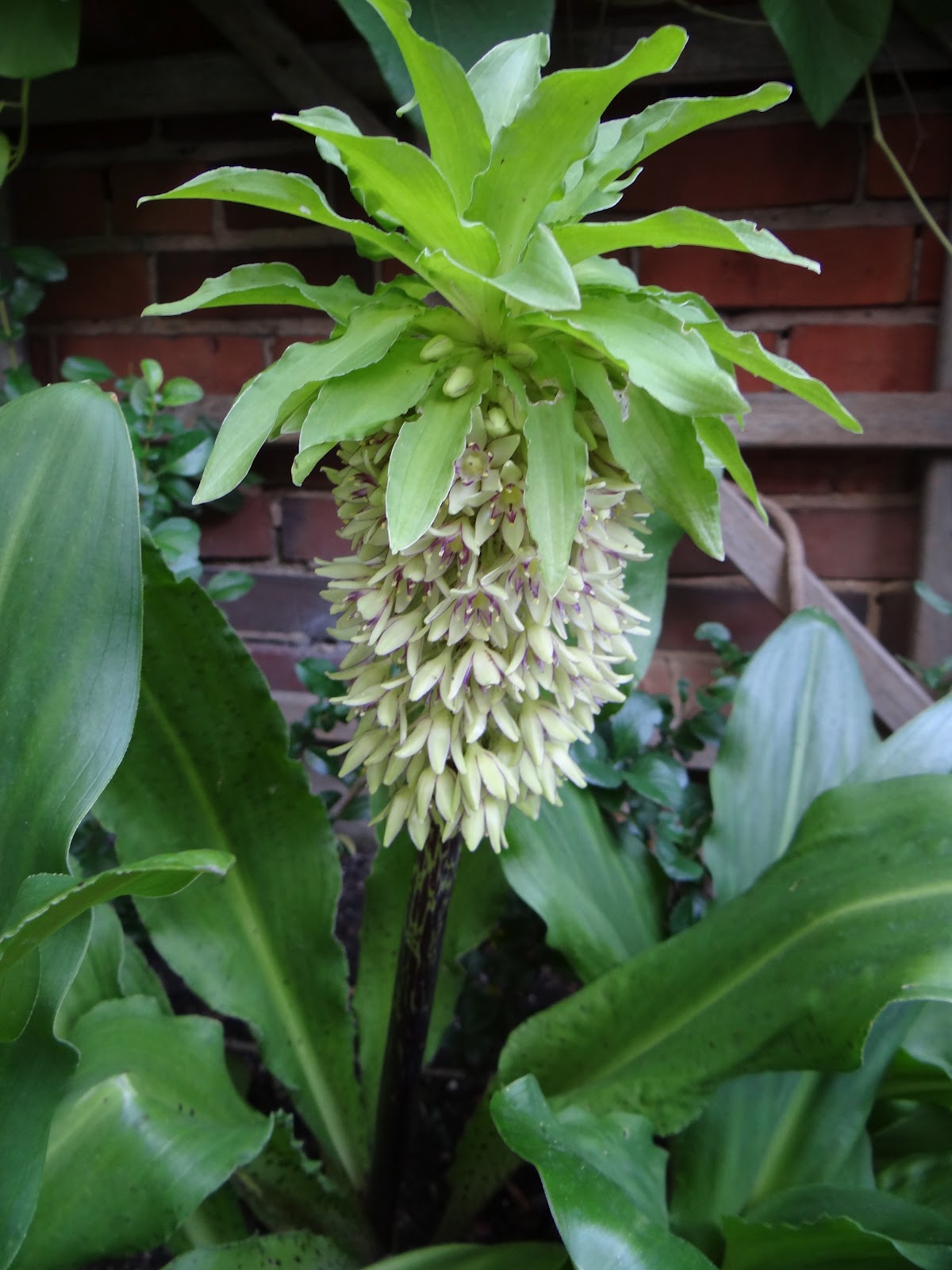
Eucomis bicolor


Eucomis 'Aloha Leia'

Belamcanda chinensis

Dianthus superbus 'Alba'

Hebe 'Raspberry Ripple'
Pelargonium sidoides


Punica granatum 'Nana'

Neofinetia falcata


This small growing monopodial orchid from Japan and Korea with just one species is a distant relative of Angraecum from Madagascar. Hard to believe! It is an erect growing epiphyte. Small clusters of up to 8 flowers are produced on compact clumping plants in summer. The flowers are delightfully fragrant, reminiscent of candy but only in the evening and early morning, then the scent dissipates only to return again. They are pure white with long 2 " spurs. I grow mine in New Zealand Sphagnum moss and bring it out for the summer into my greenhouse where it recieves shade with bright light. It also enjoys high humidity. I look forward to the blooms every year.

Sunday, 8 July 2012

Aromatic Albuca

Yesterday I hosted a fabulous garden party for Cameron and Rhoda McMaster, who travelled all the way from South Africa to spend some time here in the Northern Hemisphere. A good time was had by all, and the weather was perfect.  I was in my element, and thrilled to share, and talk with Cameron about my collection of SA plants.  I thought to myself , why not do a post on Albuca, afterall, I have my recent trip photos I can include. How lovely would that be!
Albuca shawii is currently blooming in my pot, and A. humilis has already finished. A. shawii has fragrant flowers, and the grass-like foliage smells like a lemon or lime when rubbed slightly. The plant has a great deal of garden merit with candelabras of small nodding yellow flowers, with a green central stripe. Albuca is a genus from South Africa with approx. 70 species. The Albuca featured here come from the summer-rainfall region.

A. shawii


A. fastigiata (Cradock)


A. humilis (Naudes Nek)


Saturday, 30 June 2012

Alluring Agapanthus

Awww the beautiful purple of Agapanthus! I love the piercing colour, and find Agapanthus to be a statuesque, regal plant, one that should be included in any summer garden. They are long lasting, an extra bonus. From where else, South Africa, but of course! I grow an Agapanthus cultivar of which I do not know the name of. It is outstanding!

Agapanthus praecox, the largest of the evergreen species is photographed below. Gaikaskop, Amatola Mtns., S.A. 2000M. January 2012. It is one of the most commonly grown ornamentals in the world. I live in Zone 6, and can overwinter this outdoors in the ground with mulch.


Thursday, 21 June 2012

Colourful Calochortus

I quite like the genus Calochortus, however I only grow 1 at present clavatus var. clavatus.  A few years ago I purchased some from Telos Bulbs a great nursery in California.  I grew a total of 4 species of which I lost 3. Next year I have decided to order more.  They occur from southern British Columbia down to Mexico and Guatemala, with the largest concentration in California. They grow from perennial tunicated bulbs. The common name for the most part is Mariposa Lily, however the campanulate species are known as Fairy Lanterns, and another type called cat's ears is so called as the flowers look like pussy ears. Mariposa comes from Spanish and means "Butterfly", quite aptly named as the flowers of many species resemble the eloborate colours and shapes of a butterfly. They comprise some 70 species and grow in grasslands, and chaparral on dry slopes and hillsides.

C. clavatus var. clavatus has lovely yellow flowers from California, and stands 30cm tall and is grown in my cold greenhouse for the winter.

Sunday, 10 June 2012

Chinese Charmer

Polygonatum prattii is one of my favourite of the genus. I currently grow P. hookeri, P. falcatum, P. prattii and soon P. aff. graminifolium. The Chinese Polygonatum are delightful. I look forward to their appearance every year, as it is amongst some of the later plants to make their debut in the garden. They are a north temperate genus of approximately 60 (39 in China, half endemic. They are rhizomatous perennials with pendulous flowers, solitary or clustered at the nodes. Prattii is 30cm and comes from w. to sw. Sichuan, and nw. Yunnan.