.

.
Lily Lion Heart

Sunday, 3 February 2013

Bold Beauties!

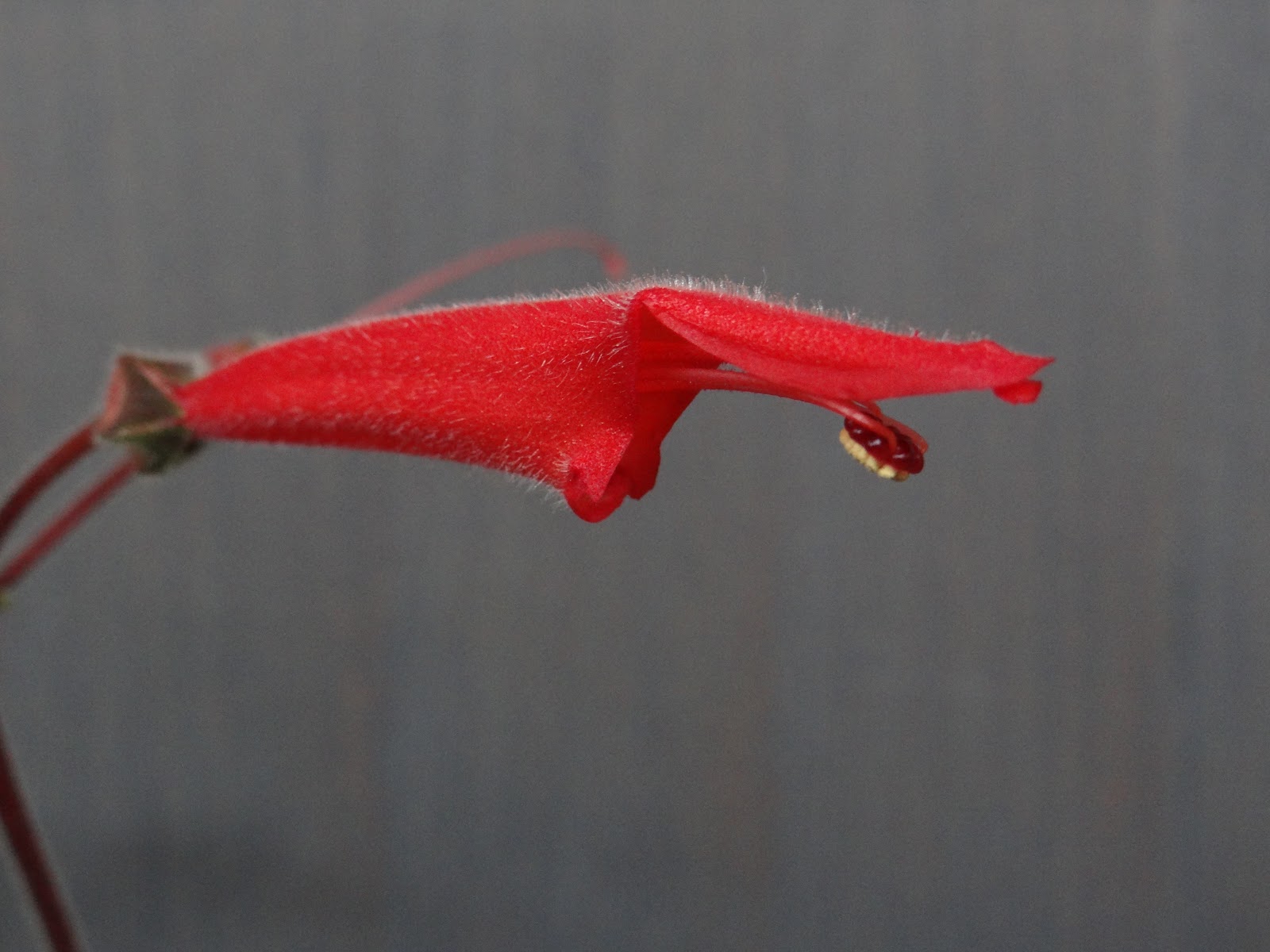
I always look forward to February as this is when my Sinnigias wake up from their brief dormancy to once again display their gorgeous tubular  flowers in colours of  red, pink, orange , white, purple, mauve, and some are spotted. The species featured here are Sinningia micans and S. iarae. They both come from the Sao Paolo state of Brazil. I grow mine with the tuber raised to create an unusual aesthetic.

 Sinningia micans has red candelabra-like flowers which rise from the top of a set of 4 leaves. This Sinningia is harder to bloom , and I find that when it sprouts new growth I end up taking most of it off.  If I do not, the result will be no buds, as the tuber has put all of its energy into the growth points. Leaving 1 or 2 tips gets results. The pollen from Sinnigia flowers tends to fall onto the leaves dotting it with a dusting of sulphur yellow.  The tuber surface looks like the parched desert of  the Kalahari.

Sinningia iarae- has orange or salmon coloured blooms. This Sinningia is easy to please, and I can flower it 2-3 times per year. It is very floriferous, with the tuber somewhat rounded. The dormant period is very brief, as least under my growing methods. The leaves are deep forest green in contrast to S. micans which is a lawn green.

Sinningia mican


Sinningia iarae


S. micans (top)
S. iarae( below)

Saturday, 26 January 2013

Winter Greenhouse Goodies

On a cold winters day nothing warms your heart more than seeing changes in the plants in the greenhouse. Over 1 week ago the buds of  Colchicum kesselringii emerged.  My greenhouse is kept heated at 3-8 Celcius , and when the sun shines it can reach 15 Celcius. I have a fan to cycle out warm air so it remains cooler. For the last week plus we have had sub-zero temperatures.

The plants I grow in the greenhouse vary from South African bulbs, to other bulb genera such as Crocus, Tecophilaea, Calochortus to name a few. I also grow alpines, Onco, Juno, and Reticulate Irises, and Asarum. The list goes on. Featured here is C. kesselringii, a late winter blooming Colchicum. This Colchicum is found in Tajikistan and Afghanistan. The colour of the exterior petal is extremely variable. Mine are varied in colour as seen below. It blooms when leaves are present, and is a small Colchicum, 3-4" in height. There are two corms in the pot, and I will likely add to this post, once there are more flowers. More greenhouse goodies to come......


Tuesday, 1 January 2013

Winter 2013

Happy New Year! Awww Winter in the Northern Hemisphere! I quite enjoy Winter, the snow, the crisp clean air. We have had a nice amount of snow thus far which was sorely missed ( at least by me) last winter. It was a very dry, milder than normal winter.  Well, it certainly looks, and feels like Winter out there. The days are slowly getting longer now. I went out along Lake Ontario to do some birdwatching. Unfortunately I don't possess the best camera for photographs that are distant. Below are some images from this foray.

Bufflehead

Common Goldeneye

Mallard

Hooded Merganser

Red-Breasted Merganser ( Male and Female)

Greater Scaup (Male and Female)

Sunday, 9 December 2012

Botanical Prints

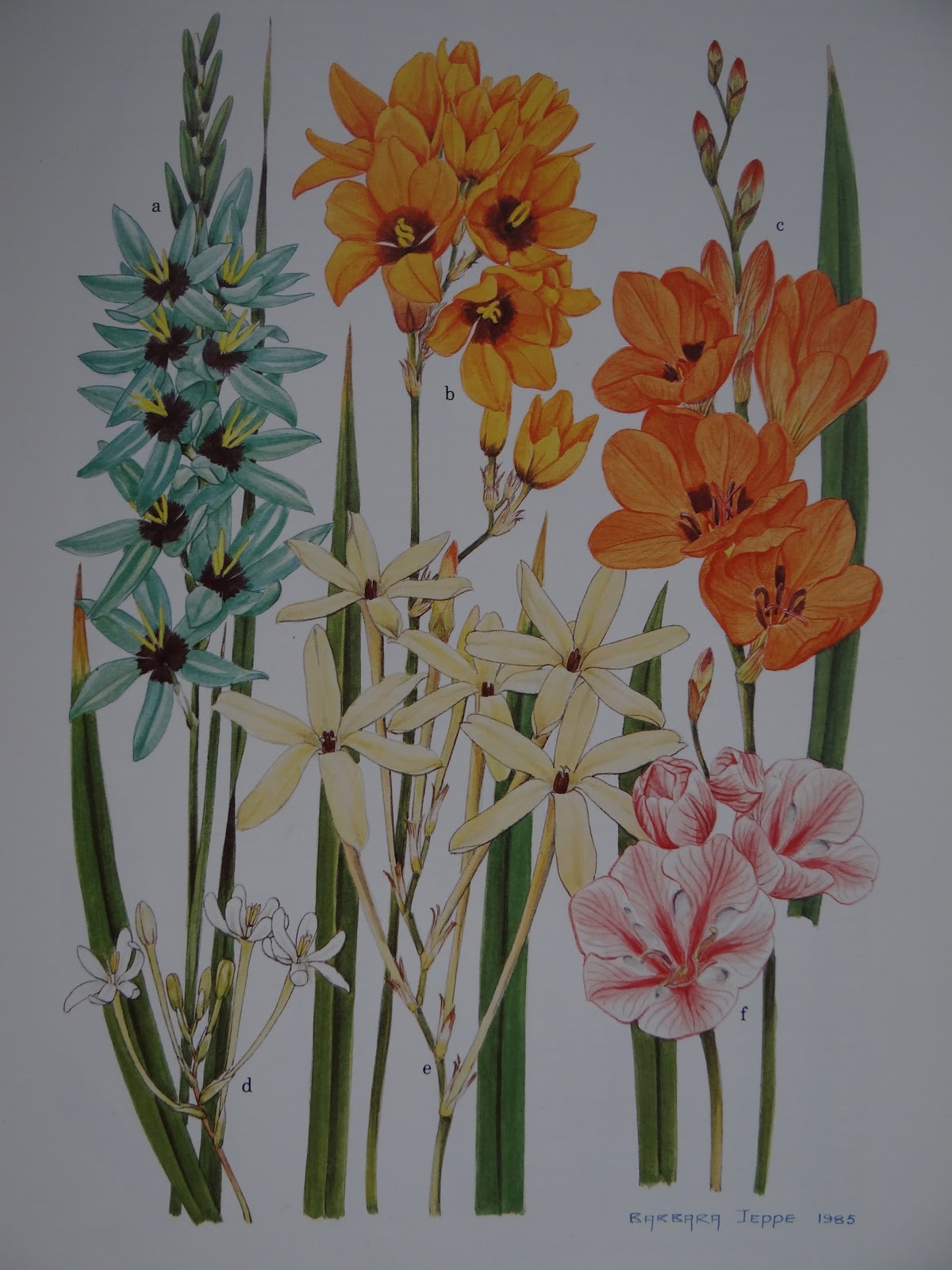
Books that represent botanical prints often make beautiful coffee table books. Well, 'Spring and Winter Flowering Bulbs of the Cape' is no exception. The botanical artist Barbara Jeppe, now deceased provided the watercolour drawings for this 1989 publication from Oxford University Press, with text by Graham Duncan. I acquired this book (free) at an estate sale earlier this year. What a special find indeed! The print colours, textures, and shapes are remarkable, very true to plants found in habitat.

Barbara, the artist criss-crossed the Western Cape, and Namaqualand seeking specimens for illustration, as well as material in private collections, and those of Kirstenbosch Botanical Gardens in Cape Town, RSA. She was surely a Maven of botanical art in South Africa. Her legacy is being continued by her daughter Leigh Voight.

Below are a mix of her extraordinary drawings.

Daubenya and Androcymbium

Massonia sp.

Lachenalia sp.

Geissorhiza sp.

Ixia and Tritonia

Moraea sp.

Saturday, 17 November 2012

Noble Nerines

I love late fall, for it is when the Nerines begin to blossom. The only problem is that the enjoyment of seeing the blooms is somewhat dampened by the chillier, shorter days. Nevertheless, these bulbs from South Africa have found their way into my heart. I must admit that I was never big on Nerines, until I travelled to SA. Well now I'm smitten. Nerine bowdenii is the  hardiest, to -15° Celsius. This fall, found my N. bowdenii to be almost one month behind schedule. We have had a cooler than normal fall accounting for this delay, however on the upside the other Nerine species I have in my collection have lasted quite long, 4 weeks plus due to this cooler weather. There are 23 Nerine species all occuring in Southern Africa. They are all well suited to cultivation in containers.

N. undulata - Summer growing- 30-60cm- spider-like undulating petals. This species is almost evergreen, as it  has a short dormancy.


N. huttoniae- Summer Growing 30-40cm- Cradock, Eastern Cape, SA. Photographed in habitat-The most unusual Nerine, and one of the rarest.


N. bowdenii- Summer growing- 30-70cm

N. humilis - Winter growing 15-45cm- has crisped tepal margins
 

Sunday, 4 November 2012

November Nuggets

Conophytum meyeri


Bulbophyllum 'Elizabeth Ann Buckleberry' (longissimum x rothschildianum)

Thursday, 25 October 2012

Crazy for Cono's

I simply adore Mesembs, and have been collecting them, and growing them from seeds for a few years now. Conophytum in particular is my favourite Genera. Conophytums have such interesting shapes, body colours, and markings. They are utterly fascinating!  I currently grow 16 species. Below is C. cupreatum, almost 2 years old, and raised from seed. Note the transparent bodies with markings that run through the bodies like veins. One could almost see right through them. Most interesting however, is the little pimple ( flower bud) in the foreground just waiting to break the skin. It seems that it has been suspended in time inside the body, and is screaming to get out but can`t quite make it. I am not sure if this bud will mature, as it should have burst through the skin by now. Such a curiosity!